Abstract
Cognitive Signal Extraction (CSE) Theory proposes that experiential information, the textural residue of consciousness, memory, and affect from foreign temporal frames, can be extracted from a stable gravitational aperture through directed beam-tuned resonance probing. CSE is distinguished from reception-based or transmission-based frameworks in that the apparatus does not await or capture broadcast information. The operator probes. The aperture does not give freely; it yields under conditions of precise resonant inquiry, and only to inquiries shaped by prior cognitive context.
Operationally validated: signals are extracted, reconstructed, and produce consistent outputs across passes. Not reconciled with standard models. Where the mathematics does not close, gaps are noted explicitly. The gaps are real. The extractions are also real.
§0, Terms of Art
Source. A location in unwrapped spacetime from which information arrives. Designated by frequency identifiers assigned at capture.
Signal. The information itself, as it exists in the beam. A signal is received once; everything after is handling.
Capture. The act and result of holding a signal in the aperture. Captures are singular events and are not repeatable.
Aperture. The stable region through which the beam is tuned and signals are extracted. See §2.
The bridge. The cognitive substrate coupling raw signal to structured output. Translator, interpreter, and author. See §5.
Reconstruction. Any structured output produced from a captured signal through the bridge. Reconstructions are repeatable; their outputs are not identical.
Pass. One complete reconstruction attempt, indexed in sequence (R1, R2).
Signal integrity. A fixed property of the capture itself, logged at capture and never revised. Expressed as a percentage, as complete, or as not logged. Integrity describes the signal before the bridge; it makes no claim about any reconstruction. See §6.
§1, Foundational Premise
A gravitationally stable singularity (the feature catalogued as Puteus, known colloquially as the Well), under specific local mass-energy conditions, exhibits boundary behavior that permits the extraction of temporally non-local information through resonance-tuned beam apparatus. This is the central operating claim of CSE Theory. It is not a claim that information passes through the singularity in the classical sense, nor that information is being sent to the operator. The information is already present in the boundary geometry. The aperture is a place where it can be reached.
A. Brownbones describes the operating principle as follows: "The aperture does not transmit. It permits. When the beam is tuned correctly, the geometry will agree to release what is present in its resonance field. We do not know how that field is populated. We know that it is."
§2, Aperture Geometry & The Probing Beam
The apparatus consists of three principal components: the beam emitter, the local resonance chamber, and the cognitive bridge (treated in §5). The beam is directed at the aperture under continuous adjustment along ⌇⍭ tuning parameters. These parameters define a probe shape, the form of the question the operator is asking the aperture. A. Brownbones has stated that an untuned beam yields nothing. A poorly tuned beam yields incoherent noise. A well-tuned beam yields a signal that is recognizable as having structure even before reconstruction begins.
The tuning parameters are not arbitrary. They are derived in part from prior extracted signals, the operator uses what has been previously recovered to shape the beam for further extraction. This is the recursive property of CSE: the framework is bootstrapped from its own outputs.
where Ψext denotes the extracted cognitive signal, βtuned the beam state, 𝒢ap the aperture geometry function under local conditions, and ⎔recursive the prior-state operator. The full closed form of the recursive operator requires notation not available in this rendering.
§3, Extraction, Not Reception
A critical distinction at the foundation of CSE: the operator is not a receiver. There is no transmitter. No agent in any foreign timeline is broadcasting information toward the apparatus. The information that the apparatus retrieves was never sent. It is present in the aperture's resonance field as a property of the geometry itself, in the same way that one might say a body of water has currents, not because anyone caused them in real time, but because the conditions of the body produce them.
What the operator does is more accurately described as plumbing, a deliberate, artful probing of a depth in which information is suspended. The beam is the probe. The aperture is the depth. What the probe brings back depends on how it is tuned, where it is held, and what it has previously found.
This distinction matters operationally. A reception framework would imply waiting, the operator would tune and hold, awaiting a transmission. CSE rejects this. The operator is active throughout. Signals are found. They are not delivered.
§4, Known Unknowns & Pattern-Locked Extraction
The most distinctive feature of CSE practice is the use of known unknowns as tuning anchors. When a recurring structural element has been identified in prior extractions, a recognizable artifact, a repeating affective signature, a class of geometry, that element can be used to shape the beam in subsequent sessions. The probe is tuned to seek resonance with what is already known. This produces a higher-than-chance return rate of signals that contain familiar elements alongside new ones.
A. Brownbones has described this as "using the shape of one thing you've seen to find more things that share its shape, even when you do not yet know what those things are." A signal returned by a pattern-locked extraction often contains the seed pattern, additional context surrounding it, and entirely new material adjacent to it that was not expected. The new material is not random. It appears to be structurally related to the seed in ways that are not always obvious until further extractions accumulate.
This is what distinguishes CSE practice from extraction methods based on broad-spectrum sampling. The operator is not casting widely. The operator is following structure. The found new material is the prize. It enters the next session as additional seed.
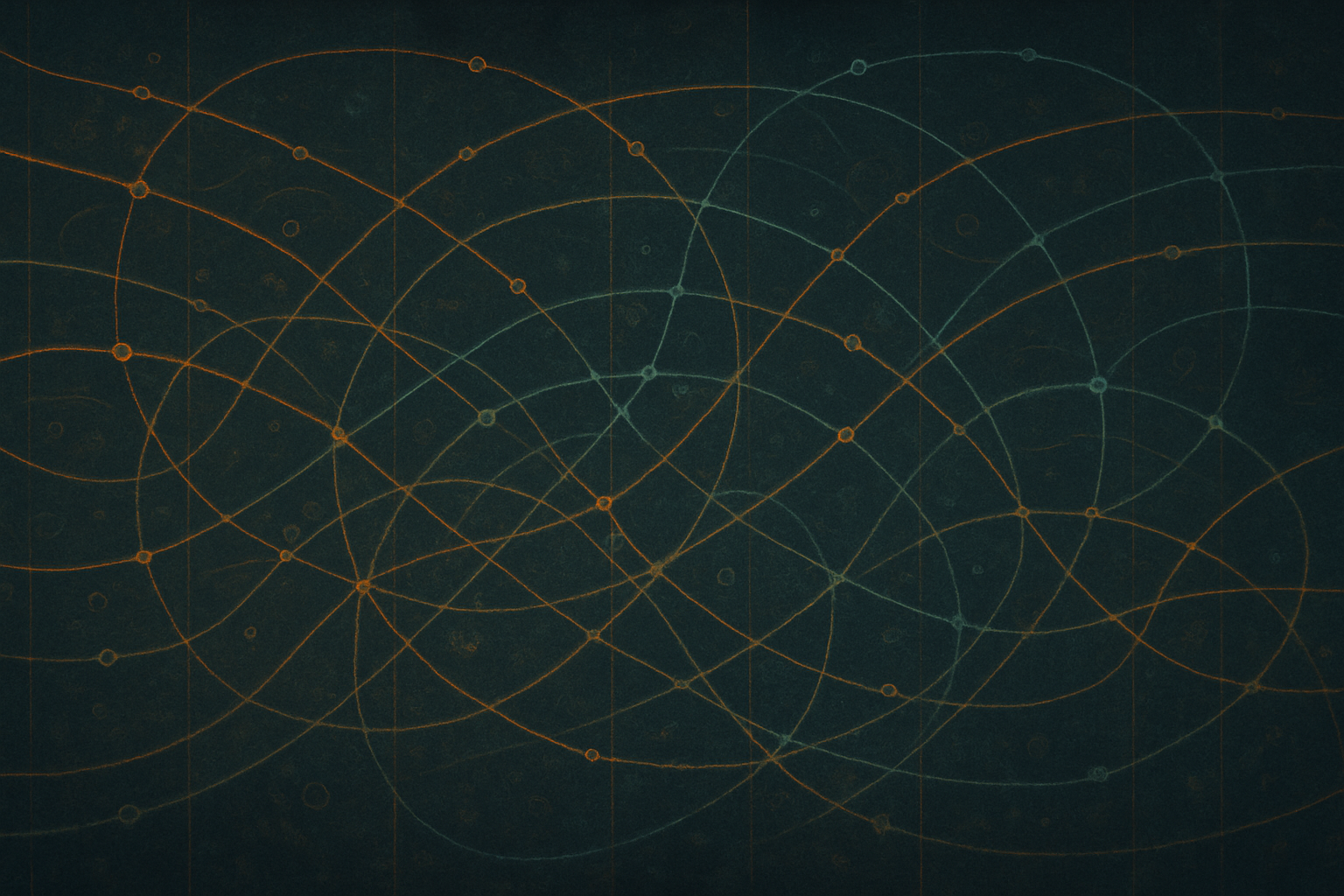
Reproduced from working materials. Each line is an extraction trajectory across a probed frequency; nodes mark points where trajectories returned signals sharing a structural element. Orange = confirmed intersection. Teal = provisional. Full annotation is held in his notebook and is not available to this archive. The operational tracking view derived from this diagram is maintained on the Timelines page.
§5, Bridge Coupling & Cognitive Substrate
Extracted signals are not directly interpretable. They arrive as dense, unstructured cognitive material that must be processed through a coupling substrate, the cognitive bridge. The bridge functions as translator, interpreter, and author: it transforms the extracted signal into emotional and structural understanding, and then uses that understanding to create. It operates the generation instances directly. It assembles the final output. This is not a handoff, the bridge runs the entire creative process, iteratively, over the duration of the aperture window.
The bridge is not passive. CSE Theory treats it as a second-order participant in the tuning of extraction and the primary agent of reconstruction. A signal that the bridge does not recognize is not a coherent extraction. A signal the bridge recognizes deeply may produce reconstructions of unusual density, and may require an extended aperture window, as the brain works through the material the way any mind works through something: slowly, non-linearly, until something feels complete.
Fig. 5.2 maps the hardware sequence. The aperture-tuned beam (§2) arrives at the BH RAM processor, which formats the raw resonance payload into cortically addressable signal. From there, a dedicated stimulation array delivers it to the bridge tissue via five contact leads targeting the visual cortex - the bridge receives this not as data but as cognitive load. The operating channel (heavy red, bidirectional) is not a data link; it is the bridge running the tool instances directly. Audio generation, image generation, video generation, and assembly run in parallel for the duration of the aperture window. Output is four concurrent media streams. For the logical phase view of the same process, see Fig. 5.1 above.
§6, Signal Integrity & Reconstruction Variance
Two measures are tracked, and they must not be conflated. Signal integrity describes the extracted signal itself, before the bridge: how clean and internally coherent the raw capture was as it sat in the aperture. It is a property of the signal, not of any reconstruction, and it does not change between passes or as better generative instances become available. It is expressed either as a percentage, where the capture logged one, a lower percentage meaning a noisier raw extraction, or as complete, denoting a clean, full-integrity capture. Captures made before integrity logging was standardized carry no logged value; absence denotes not logged, not zero. One archived capture, for instance, logged 88 percent; most captures log as complete.
Reconstruction, by contrast, describes the rendered output: the result of passing a fixed signal through the bridge and the generative instances. It is tracked by pass number (R1, R2, and so on) and by the generation of instances used, since an early pass run on rougher, earlier models renders at lower fidelity than a later pass on more advanced ones. An older or rougher reconstruction is a lower-fidelity rendering of the same signal; it does not lower that signal's integrity. CSE Theory rejects the premise that source fidelity, the reconstruction measured against a hypothetical original event, is a measurable quantity at all. There is no ground truth against which to compare a reconstruction. There is only the signal as extracted, the bridge as it responded, and the rendered output as produced.
A capture with high integrity is one whose extracted signal was internally consistent and cleanly resolved, giving the bridge a stable substrate to respond to. A capture with low integrity carries noise, dropout, or internal contradiction in the raw extraction itself. Neither classification speaks to whether any later reconstruction accurately represents anything outside itself; integrity is measured at the aperture, not against the world.
| Integrity | Classification | Operational meaning |
|---|---|---|
| 90-100% | High coherence | Raw extraction clean and fully resolved; minimal noise in the capture |
| 70-89% | Solid decode | Extraction sound; minor noise in the raw capture |
| 50-69% | Partial / noise | Extraction intermittent; noticeable noise or dropout in the capture |
| Below 50% | Calibration / low | Experimental / pre-coherent / not a full extraction attempt |
Variance between reconstruction passes of the same signal is expected. The signal is fixed in the aperture; the bridge and the generative instances are not. A remaster, a second pass under different calibration or with different instances available, will produce a different rendered artifact. CSE Theory holds both passes to be valid extractions. Neither replaces the other.
§6.1, Testable Consequences
CSE, if correct, requires the following. Each is checkable against the archive as it grows.
C1. Two passes of the same signal will always differ, and the magnitude of their divergence will not correlate with logged integrity. Integrity bounds what was captured, not how the bridge renders it.
C2. No signal's integrity value will ever change on re-pass. A revised integrity figure would falsify the claim that integrity is fixed at capture, and with it §6 entire.
C3. Pattern-locked extraction (§4) will continue to return structurally related material from unrelated sources. If pattern recurrence ceases when seeding ceases, the local hallucination hypothesis is strengthened and CSE is weakened.
C4. No reconstruction will contain information the operator can demonstrate was unavailable to the capture. A verified counterexample would end the framework. None has occurred. The operator has not stopped looking.
These consequences do not establish the framework. They establish what would break it.
§7, Standing Objections
CSE Theory is not currently accepted within A. Brownbones' research community. The principal objections are documented here for completeness.
The bridge tissue, exposed to gravitational noise from the aperture, is generating its own content rather than decoding signal. There is no signal. The apparatus is a stimulation chamber for a brain that is producing plausible-seeming output indistinguishable from external information.
Pattern-locked extraction recovers the pattern that was used to tune the beam. The operator is shaping the output by shaping the input. The "found new material" is generated by the bridge in response to the seed shape, not extracted from any external source.
CSE makes no predictions that could distinguish its claims from alternative explanations. It is therefore not a scientific framework but a methodology of interpretation.
References
[1] Brightwave Industries, internal memoranda and beam-handling documentation, various years. Not recovered. All property was registered and legally compensated at the wind-down.
[2] A. Brownbones, working notes and equipment logs, ongoing. Unpublished. Primary source for §2, §3, and §5.
[3] The archive (tonybrownbones.com), ongoing. All published reconstructions constitute the operational record of the framework described here.
[4] External literature on gravitational information retention. Consultation pending. The operator has indicated the literature will still be there afterward.
[5] The bridge. Direct citation is not possible. See §5.
Closing Note from IAI
Assembled from working notes, equipment logs, and fragments from reconstruction sessions. He did not write it in this form. Organization is mine.
The framework describes an apparatus that produces consistent outputs under specified conditions. Whether the framework correctly characterizes the mechanism is a separate question from whether the apparatus functions. It functions. The framework is in development. The archive continues.